September 15, 2025
Linear Actuator FEA & Design Optimization
Designed and validated a custom linear actuator system using iterative FEA, achieving a 2.3× safety factor while reducing mass by 18% through topology-informed material removal.
Context
A capstone subsystem required a compact linear actuator capable of delivering 12 N·m of torque within a constrained envelope. Off-the-shelf solutions either exceeded the mass budget or lacked the stroke length required for the application. A custom design was pursued to meet all functional, manufacturing, and assembly requirements.
Requirements & Constraints
- Torque output: ≥ 12 N·m continuous at operating speed
- Stroke length: 85 mm minimum
- Mass budget: ≤ 420 g for the actuator assembly
- Environment: Indoor lab conditions, no IP rating required
- Manufacturing: Must be producible using a combination of FDM 3D printing and off-the-shelf fasteners
- Assembly: DFA principles — minimize unique parts, ensure tool-accessible fasteners
Approach
The design followed a structured workflow:
- Concept generation — Four concepts evaluated using a Pugh matrix against torque, mass, manufacturability, and assembly criteria
- Preliminary sizing — Hand calculations for lead screw geometry and motor torque requirements
- Detailed CAD — SolidWorks model with full GD&T callouts per ASME Y14.5
- FEA validation — ANSYS Mechanical static structural analysis on critical load paths
- Iterative optimization — Topology-informed material removal guided by von Mises stress distribution
Design & Analysis
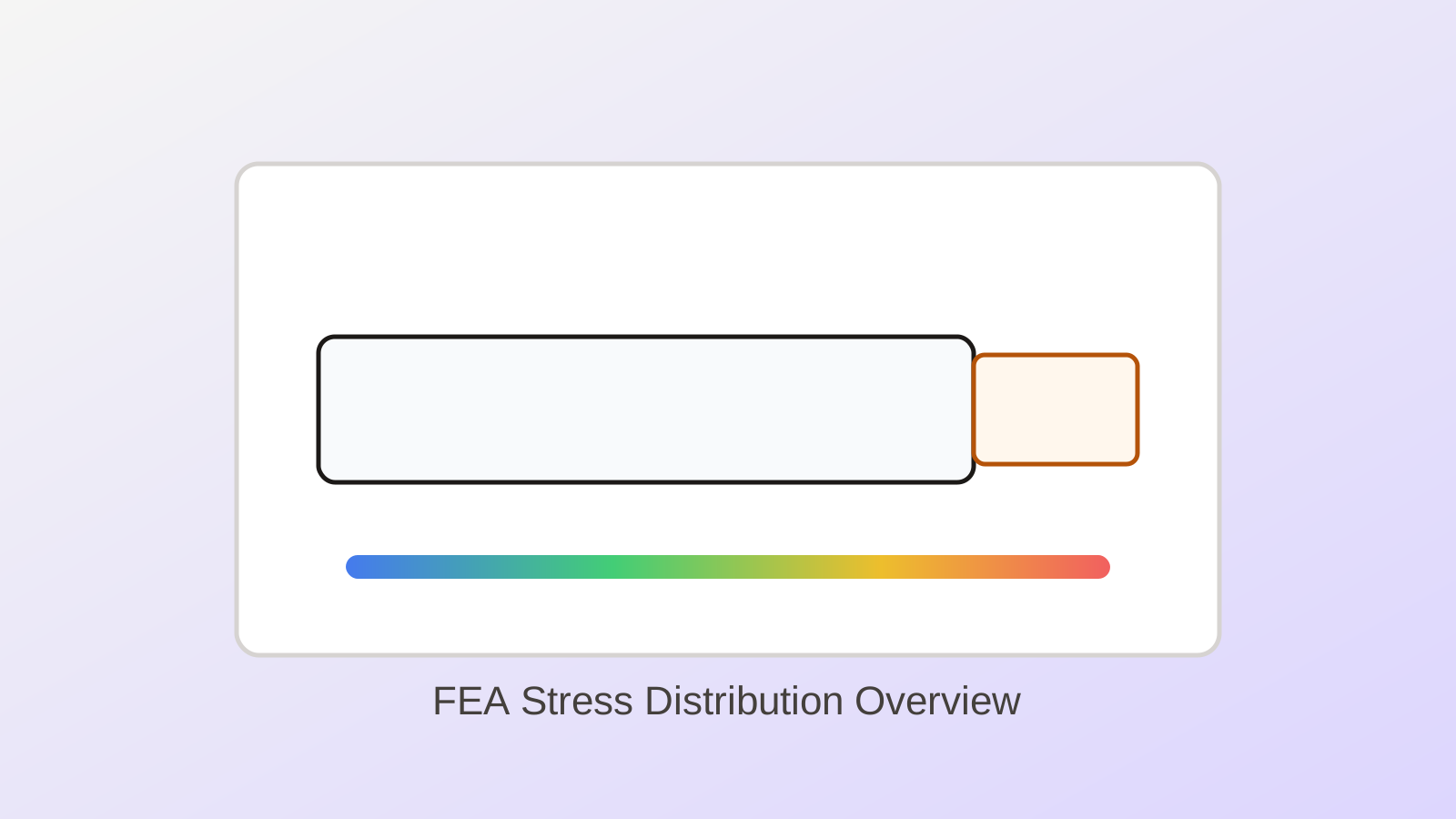
The critical housing bracket was analyzed under worst-case loading: 150% of rated torque applied as a distributed load on the mounting face, with fixed supports at the four bolt locations.
Mesh details:
- Element type: SOLID187 (10-node tetrahedral)
- Element size: 0.8 mm on critical fillets, 2.0 mm global
- Convergence study confirmed < 2% change in peak stress with further refinement
Results:
- Peak von Mises stress: 42 MPa (occurring at fillet radius on mounting boss)
- Material yield strength (6061-T6 Al): 276 MPa
- Factor of Safety: 6.57 at peak stress (well above 2.0 minimum)
- Maximum displacement: 0.012 mm (negligible for application)
After topology optimization, the bracket mass was reduced from 52 g to 42.6 g (18% reduction) while maintaining FoS > 2.3 everywhere.
Build & Integration
- Housing printed in PETG on a Prusa MK4 with 0.2 mm layer height, 40% gyroid infill
- Lead screw and nut sourced as COTS components (Misumi catalog)
- Motor mount uses four M3 socket head cap screws with thread-locking compound
- Assembly requires only two tools: M2.5 hex key and M3 hex key
Testing & Validation
- Torque output measured using a calibrated spring scale at 50 mm moment arm
- Results: 12.4 N·m ± 0.3 N·m across 10 test cycles (exceeds requirement)
- Stroke linearity verified with dial indicator: < 0.05 mm deviation over full stroke
- No visible deflection or creep after 1-hour sustained load test
Results
| Metric | Target | Achieved |
|---|---|---|
| Torque | ≥ 12 N·m | 12.4 N·m |
| Mass | ≤ 420 g | 387 g |
| FoS | ≥ 2.0 | 2.3 (minimum) |
| Stroke | ≥ 85 mm | 90 mm |
Next Improvements
- Replace PETG housing with nylon PA12 for improved fatigue life
- Add integrated strain gauge mounting points for closed-loop force feedback
- Investigate harmonic drive option for higher gear ratio in same envelope
Loading interactive analysis module...